

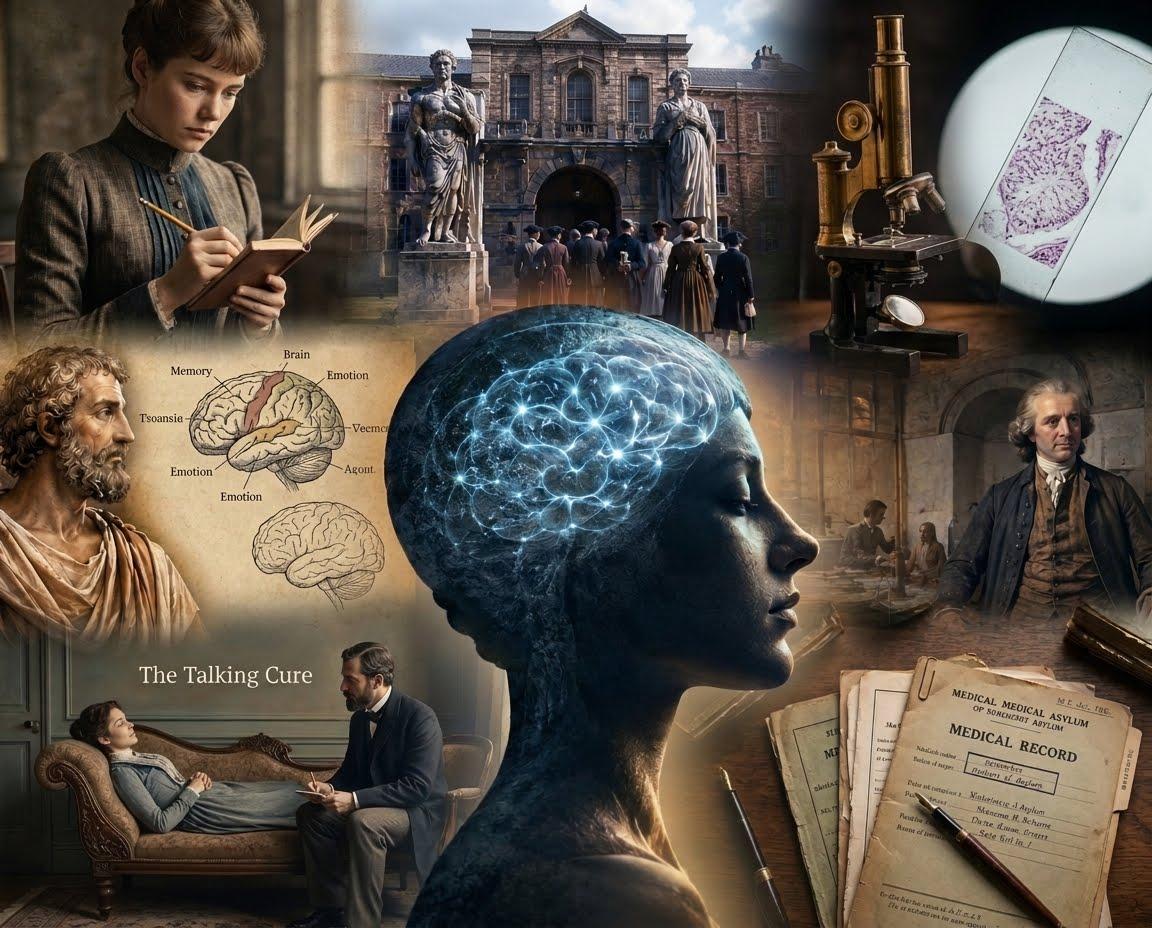
CHAPTER 2: BEING HUMAN
CHAPTER 2: BEING HUMAN
How We Invented Modern Psychiatry
Imagine waking up tomorrow morning in a locked room and realizing that absolutely nobody believes a single word you say.
You know your name. You know where you are. You know you are perfectly sane. But a group of men in white coats have written a word in a file, and the more you calmly insist that you don't belong here, the more they smile, nod, and write down your protests as definitive psychiatric proof of your deepening madness.
Can you imagine being trapped in a loop where sanity itself looks like a symptom?
By the late 19th century, the heavy iron chains of medieval dungeons were officially gone, replaced by a massive, global phenomenon known as the Great Confinement. Giant, state-funded asylums sprouted up across Europe and America to house a surging population of troubled souls.
But as the heavy oak doors clicked shut, a dark, unsettling question began to echo through the medical community: How many perfectly healthy people were currently buried alive inside these fortresses—and how could anyone outside tell the difference?
🕵️♀️ The Undercover Stunt That Shocked New York
In 1887, a daring 23-year-old journalist named Nellie Bly decided to test the system by staging history's most dangerous undercover investigation. Her mission was simple yet terrifying: feign madness, get herself legally committed to the notorious Women's Lunatic Asylum on Blackwell's Island, and report the unvarnished truth from the inside.
Bly spent nights practicing wild, unblinking stares in her mirror. She checked into a temporary boarding house under a false name, spoke in fragmented, paranoid riddles, and successfully duped New York's top medical examiners. Within days, she was ferried across the East River to the island asylum.
What she uncovered wasn't a place of healing; it was a gothic house of horrors.
Patients were forced to sit perfectly still on hard benches for 14 hours straight without talking. They were subjected to skin-cratering freezing baths, fed rotten food, and choked by abusive guards. But Bly’s most chilling observation was how the system weaponized language. She met sane immigrant women who had been locked up simply because they couldn't speak English and panicked during their medical evaluations.
After ten agonizing days, a corporate lawyer managed to secure her release. Her explosive exposé, Ten Days in a Mad-House , forced a grand jury investigation and a massive public funding overhaul. Yet, it left a haunting systemic mystery wide open: if doctors could be fooled this easily by an actress, what exactly were they looking for inside the human brain? Check out the fully digitized archive of Nellie Bly ’s historic Ten Days in a Mad-House reporting via the National Library of Medicine.
🧠 The Microscopic Secret of Auguste Deter
While American journalism was exposing asylum scandals, a meticulous German doctor in Frankfurt was staring down a microscope, hunting for the literal, physical footprint of madness.
In 1901, a 51-year-old woman named Auguste Deter was admitted to his ward. She was young, but her mind was aggressively unraveling. She was profoundly confused, intensely suspicious, and completely lost her short-term memory. When her doctor asked her what she was eating, she looked at the plate and whispered, "I am eating spinach." She was eating meat. When asked her name, she sighed, "I have lost myself."
Her doctor’s name was Alois Alzheimer.
For five years, Alzheimer obsessively recorded their daily conversations. When Auguste died in 1906, he did something revolutionary: he removed her brain, stained the gray tissue with silver dyes, and slid it under a microscope. What he found shocked the medical world. Her brain cells hadn't just faded; they were choked by strange, dense protein deposits and tangled, twisted neural fibers.
A few years later, his colleague Emil Kraepelin officially named the condition Alzheimer's disease. For the first time in human history, science proved that a profound psychological break could be caused by a tangible, physical erosion of brain tissue rather than a moral failure, a weak character, or a curse from the heavens.
🗣️ Anna O. and the Fraudulent Birth of the "Talking Cure"
But what if the brain looked perfectly healthy under a microscope, yet the mind was still screaming in agony?
In Vienna, Austria, a young, brilliant woman named Bertha Pappenheim —hidden from history under the clinical pseudonym Anna O. —was suffering from a bizarre cocktail of symptoms: sudden phantom paralysis, severe hallucinations, and a strange glitch where she forgot her native German and could only speak English.
Her physician, Josef Breuer, noticed a fascinating pattern. If he sat by her bedside and let her ramble unguided through her deepest, most distressing memories, her physical symptoms would temporarily vanish. Bertha jokingly dubbed this therapeutic process the "talking cure."
Breuer shared this strange case with an ambitious younger colleague named Sigmund Freud. Freud became instantly obsessed, using Bertha's experience to construct the towering, multi-billion-dollar empire of psychoanalysis—the idea that hidden traumas buried deep within the
But the historical record holds a massive, controversial twist that standard textbooks love to skip. The famous story that Anna O. was miraculously cured by talking is an absolute myth.
In reality, Bertha was never cured by Breuer or Freud; her harrowing symptoms persisted, and she spent considerable time afterward confined to an asylum. Freud and Breuer actively doctored the clinical narrative to make their new theory look flawless.
The real mystery? Bertha didn't need Freud to save her. She eventually saved herself, leaving the couch behind to become one of Europe's most revered social workers, an aggressive champion for women's rights, and a pioneer in child protection.
🛠️ The Icepick, the $200 Bill, and the Boy Named Howard
While Freud's disciples were trying to cure the mind with decades of expensive conversation, a new faction of radical doctors grew completely, violently impatient. Wards were overflowing, budgets were cratering, and they wanted a physical cure that took minutes, not years.
This brings us to Dr. Walter Freeman, a showman physician who traveled the highways of the United States in a custom vehicle cynically dubbed the "Lobotomobile."
Freeman championed the transorbital lobotomy. His clinical methodology was jaw-droppingly crude: he would knock a patient unconscious using a basic electroshock machine, slide a thin steel instrument modeled directly after an ordinary kitchen icepick up beneath the patient's eyelid, tap it through the thin bone of the eye socket using a rubber mallet, and swing it back and forth to permanently sever the frontal lobe from the rest of the brain.
It took less than ten minutes. It required no sterile operating room, no surgeon's license, and very little paperwork. It left thousands of patients permanently flat, lethargic, and emotionally hollowed out—effectively creating compliant, quiet institutional ghosts.
Can you imagine discovering your entire life was permanently altered for a $200 fee?
In December 1960, a 12-year-old boy named Howard Dully was taken to a hospital by his stepmother, who complained that the boy was moody, daydreamed too much, and was difficult to manage. Walter Freeman recommended an immediate lobotomy. Howard was never told what was happening; he thought he was just going in for routine medical tests.
The icepick surgery didn't make Howard's life easier. It shattered his inner world. He spent the next several decades drifting through state institutions, battling severe addiction, and experiencing homelessness.
But at age 50, Howard went on a deeply emotional quest for answers. He tracked down Freeman's long-locked archive files. Inside, he found the cold, clinical photographs of the icepick buried in his 12-year-old eyelids—and a handwritten invoice showing his stepmother had paid Freeman exactly $200 to alter his soul. Howard reclaimed his narrative in NPR's monumental documentary My Lobotomy, proving that the most terrifying thing about early psychiatry wasn't the madness itself—it was the absolute authority doctors held over patients who had no voice.
💊 The Little Blue Dye Variant That Emptied the Asylums
Just as Freeman’s icepick assembly line was peaking, a quiet accident in a French pharmaceutical lab brought the entire asylum empire crashing down.
In 1952, psychiatrists Jean Delay and Pierre Deniker began testing an experimental compound derived from synthetic fabric dyes called chlorpromazine (later branded in America as Thorazine). When they administered it to a profoundly manic young man, something unprecedented occurred. He didn't just drift off into a heavy, drug-induced sleep like he would on barbiturates.
He woke up, looked around his room, and calmly asked to go home. His manic delusions had vanished into thin air. Learn more about this chemical revolution through the Science History Institute’s Feature on the Discovery of Chlorpromazine.
It was the dawn of the psychopharmacology age. Almost overnight, the massive, fortress-like institutions that had dominated Western society for generations began to empty out. In 1963, President John F. Kennedy signed the landmark Community Mental Health Centers Act, declaring that the era of institutional confinement was officially dead, replaced by localized, compassionate community care.
But the gothic mystery had one final, modern sting in its tail.
Governments rushed to shut down the massive asylums to save money, but they completely failed to build the community clinics, housing, and psychological support networks patients desperately needed to survive. For hundreds of thousands of vulnerable individuals, freedom from the asylum walls didn't mean salvation—it meant being thrust into a cold world of homelessness, abandonment, and entirely new struggles. The buildings were emptied, but the human mystery remained unsolved.
Step Boldly Into the Modern Light
The path to understanding the human mind has been paved with profound breakthroughs, tragic deceptions, and an enduring, messy quest to alleviate human suffering. Fortunately, the era of undercover asylum horrors, fabricated cures, and desperate icepick surgeries is firmly buried in the past.
Today, modern behavioral healthcare recognizes that your story belongs to you—not an aggressive system or a detached clinical file. True healing requires an elegant, highly personalized balance of biological precision and deep psychological safety.
If you or someone you love is navigating your own internal maze, you don't have to face the dark alone. Discover the power of compassionate, scientifically grounded clinical support through our dedicated individual therapy at Positive Reset or explore our highly flexible, comprehensive outpatient mental health services to find your strength and move forward with absolute confidence.
Coming next in BEING HUMAN : Chapter 03: The Matrix of the Mind—Inside the Modern Brain.


We Accept Medicaid, Medicare and Commercial Insurance Plans