

CHAPTER 1: BEING HUMAN
CHAPTER 1: BEING HUMAN
A Note from the Positive Reset Team
At Positive Reset, our core mission is simple:Feel understood. Find your strength. Move forward.But to truly appreciate how far mental healthcare has come, we must first look back at where it began.
We are launching our new historical series, BEING HUMAN, not just to uncover the fascinating, often gothic mysteries of our psychological past, but to remind you that emotional suffering is not a personal failure, a spiritual curse, or a dead end. It is a profoundly human experience that generations before us have fought to understand.
By looking into the dark asylums of history, we celebrate the bright, compassionate light of modern therapy and psychiatric care that allows us to heal together today. Welcome to Chapter 1.
The human mind has always been an uncharted labyrinth. For thousands of years, long before the first psychiatric clinic opened its doors or the first prescription pad was signed, humanity was trapped in the dark with its own madness. We looked into the abyss of human suffering and saw monsters, fluids, and ghosts.
From the shifting sands of ancient Egypt to the candlelit, feces-stained galleries of 18th-century London, the story of how we tried to fix a broken mind is not a gentle tale of scientific progress. It is a gothic mystery filled with extraordinary terror, bizarre theories, and a desperate, unsettling quest to understand what happens when the human soul fractures.
🏛️ The Hospital That Became a Spectacle
London, 1742.
Imagine a crisp autumn afternoon in a metropolis of horse-drawn carriages and candlelit streets. If you were a wealthy aristocrat looking for a thrilling spectacle, you didn't just go to the theatre or stroll the shops.
You paid a penny to go look at the madmen.
That year, an astonishing 19,000 visitors paid admission to walk through the grand, palatial gates of Bethlem Royal Hospital—infamously twisted by Cockney accents into the word Bedlam. They didn't go to offer charity or comfort. They went because Bedlam was the ultimate reality television show of the 18th century, housing approximately 200 patients whose profound psychological agony was treated as public entertainment. You can explore the unsettling reality of this era through the historical archives of the Bethlem Museum of the Mind
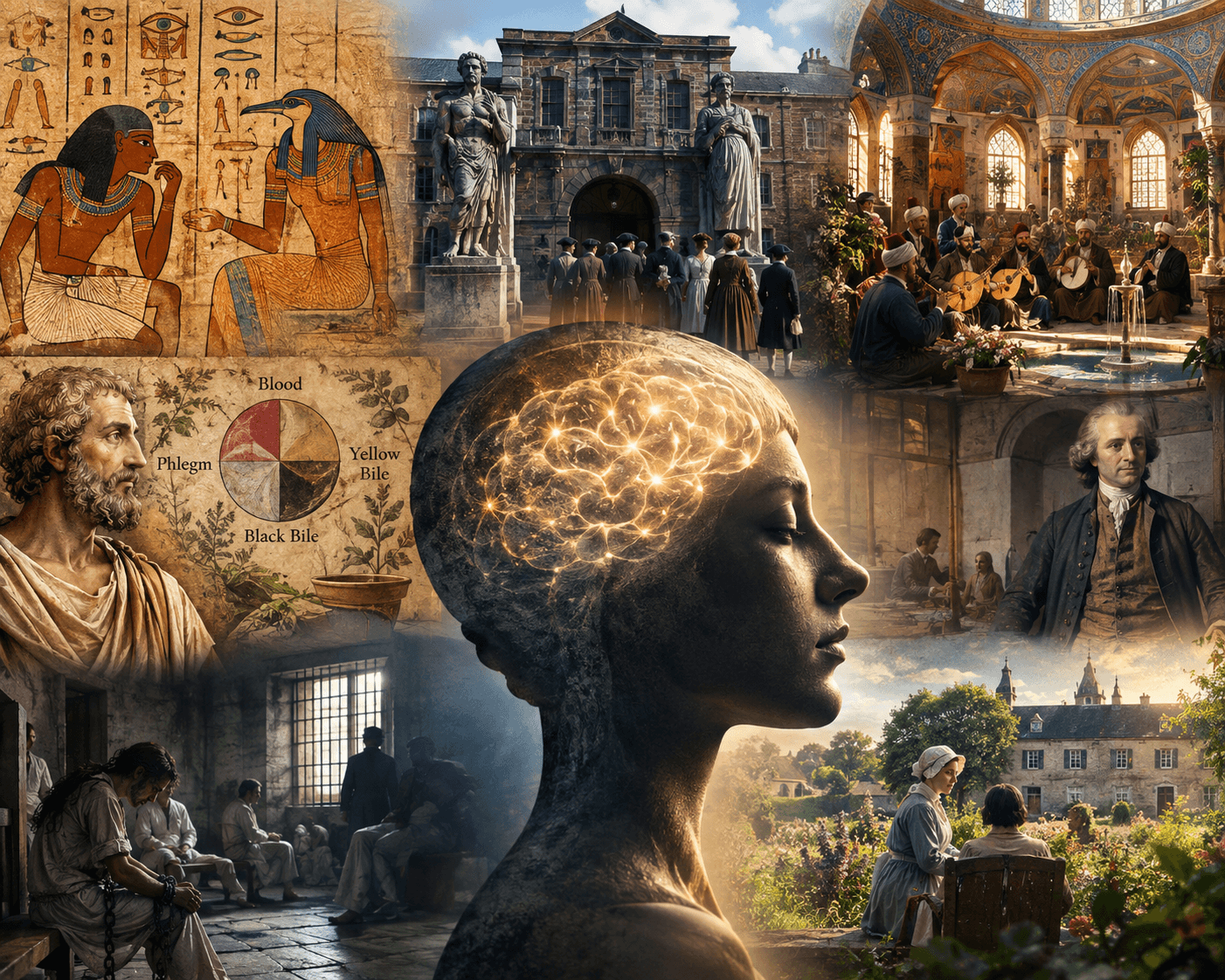
From the outside, Bedlam looked like a literal palace. Designed by the celebrated architect Robert Hooke in 1676, its entrance was guarded by two towering, deeply unsettling stone sculptures: Raving Madness, straining against invisible chains, and Melancholy Madness, slumped in catatonic despair.
But inside, it was a circus of horrors.
Wealthy tourists walked down the long, echoing galleries, poking at patients, laughing at their screams, and mocking their delusions. In 1741, a young woman wrote a deeply affected letter—published in Samuel Richardson’s Familiar Letters on Important Occasions—describing the "odd curiosity" that drove her cousins to Bedlam, only to find themselves utterly horrified by the raw, unmasked human agony on display.
The crowds became such a volatile public health disaster that the hospital’s governors finally had to shut the doors to casual tourists in 1770. But Bedlam left a permanent, dark stain on history. It proved that for a long time, society didn't want to heal the mad—they wanted to watch them like caged beasts. Bethlem’s history and public visitors
📜 Ancient Egypt: The Phantom Voice in the Papyrus
Let’s travel back almost 4,000 years.
The air is thick with the scent of cedar oil and Nile mud. There are no psychiatric clinics, no therapists, and no modern medications. Yet, sitting in the flickering lamplight of ancient Egypt, a man is arguing for his life.
He isn't fighting a thief or a pharaoh. He is arguing with his own soul.
In a breathtaking text written around 1850 BCE—found on the fragmented fibers of Berlin Papyrus 3024—we find a document known as The Debate Between a Man and His Ba. The ba was the Egyptian concept of spiritual identity, often drawn as a bird with a human head. You can view the preservation details of this ancient dialogue through the Egyptian Museum and Papyrus Collection Berlin. Berlin Papyrus 3024 — the original manuscript record
In this intimate, haunting text, the man is utterly exhausted by the cruelty of the world. He is contemplating ending his life, while his ba fights back, arguing with him, comforting him, and debating the terrifying nature of death. It is the oldest recorded dialogue about a psychological crisis in human history.
But here is the ultimate twist: the beginning of the scroll is missing.
The entire opening section has disappeared into the sands of time, leaving historians to wonder what traumatic event triggered this ancient mental breakdown. We are left reading a conversation where the first words are forever lost in the dark. Cambridge University Press: The Debate between a Man and His Soul
Yet, the Egyptians were also on the verge of a medical breakthrough. Another artifact, the Edwin Smith Surgical Papyrus (copied around 1600 BCE), reveals a physician treating a man with a shattered skull. The doctor noted a bizarre symptom: the patient was fully awake, but completely unable to speak.
Thousands of years before modern neuroscience, this nameless Egyptian healer had discovered aphasia—the direct physical link between a wounded brain and a broken mind. Though they still used magic spells and incantations to drive away demons, the Egyptians were the first to realize that when the skull takes a beating, the human soul changes shape. Research on the Edwin Smith Surgical Papyrus and the earliest possible case of aphasia
🧪 Ancient Greece: The Dark Alchemy of Sadness
Now, enter the brilliant, obsessed minds of Ancient Greece.
If you woke up tomorrow in ancient Athens overwhelmed by a heavy, unexplainable black cloud of sorrow, a Hippocratic physician wouldn't ask you about your childhood. He wouldn't blame the gods, either.
Instead, he would look at you with a grim diagnosis: "You have too much black bile."
The Greeks believed the human body was a chemical battleground ruled by four vital fluids, or "humors": Blood (the spirit of fire),*Phlegm (the chill of water), Yellow Bile (the heat of summer), and Black Bile (the cold, dry dark of earth).
When these fluids were perfectly balanced, you were sane. But if a toxic, sludge-like fluid called melaina chole (literally, black bile) began to overflow and pool in your organs, it poisoned your mind. This is where our modern word*melancholy comes from.
The cure for this chemical imbalance was brutal. To drain the phantom black bile, doctors like Galen would subject you to aggressive purging, starvation diets, or bloodletting—slicing open your veins until you were faint from blood loss, hoping to flush the darkness out of your system.
The Greeks were completely wrong about the anatomy. There is no such thing as black bile. But they did something revolutionary, something that laid the groundwork for everything that was to come: They took madness away from the gods and put it squarely into the human body.
They realized that emotional agony wasn't a curse from the heavens, but a glitch in the biological machine. They were still centuries away from the truth, but the cosmic search for the chemistry of the mind had officially begun. National Library of Medicine: The Four Humors and Oxford Research Encyclopedia: Humours
🎼 Edirne, Ottoman Empire: The Hospital With Its Own Orchestra
Now for a place that completely shatters our expectations of ancient medicine.
While medieval Europe was throwing the mentally ill into dungeons or treating them with chains, a magnificent architectural marvel opened its doors in Edirne between 1484 and 1488. Commissioned by Sultan Bayezid II, this hospital—known as a darüşşifa—approached madness with a shocking level of sensory elegance.
Inside these walls, patients didn't hear screams. They heard the symphony of the soul.
The hospital was designed around a breathtaking, massive domed hall featuring six winter rooms and four summer rooms. At the exact center sat a marble fountain that sent running water splashing through the hall, filling the space with acoustic tranquility. Directly above the water sat a raised platform built for a live therapeutic orchestra.
According to the famous 17th-century Ottoman traveler Evliya Çelebi, a dedicated group of ten elite performers came three times a week. They didn't just play random songs; they weaponized highly targeted music therapy centuries before the phrase was invented. Musicians playing the reed flute, violin, panpipes, dulcimer, harp, and lute teamed up with singers who recited ancient poems and stories.
Most fascinatingly, different musical modes (maqams) were precisely selected to target different emotional illnesses. One mode was played for deep depression; another was deployed to calm manic hysteria. The air was constantly perfumed with the intoxicating scents of fresh jasmine, carnations, tulips, and hyacinths.
This wasn't a modern psychiatric ward, but it was an extraordinary oasis of compassion. Today, this miraculously preserved building stands as a museum, reminding us that humanity once knew how to heal the mind through beauty, sound, and nature. The Külliye of Sultan Bayezid II: Psychiatry in History and Edirne Health Museum
🔓 Paris, France: The Rebel Supervisor and the Broken Chains
Let's move to the dark, damp underbelly of late 18th-century Paris.
Inside the notorious Bicêtre Hospital, human beings deemed mentally ill were treated worse than death row inmates—thrown into dark cells, forgotten, and literally kept in heavy iron chains.
But in 1785, an unexpected savior stepped into the dark. His name was Jean-Baptiste Pussin.
Pussin wasn't a celebrated doctor or a wealthy politician. He was something far more powerful: he was a former patient. In 1771, Pussin had been admitted to Bicêtre suffering from scrofula, a brutal illness of the lymph nodes. He survived the hospital, looked around at the horrors surrounding him, and chose never to leave. Instead, he became an employee, eventually rising to become the supervisor of the ward for "incurable" patients".
Because Pussin had lived on both sides of the hospital walls, he understood a profound truth that mainstream medicine ignored: treating human beings like prisoners only makes them madder.
Alongside his fierce wife, Marguerite Jubline, Pussin launched a quiet, dangerous rebellion against institutional cruelty. He looked at the guards and banned the routine use of iron chains. He proved that patients could be managed with dignity, respect, and psychological boundaries rather than cold iron. In 1791, noticing that patients were dying of sheer physical exhaustion, he boldly increased their daily bread rations.
History books often give all the credit to the famous physician Philippe Pinel for "breaking the chains" of the mentally ill. But Pinel himself openly admitted that he learned everything from watching the raw courage of Pussin and his wife. The true revolution of psychiatric reform didn't start with a medical degree; it started with a survivor who remembered what it felt like to sit in the dark. The Man Behind Philippe Pinel: Jean-Baptiste Pussin
🕊️ York, England: The Woman Who Vanished Into the Dark
Around 1790, a quiet tragedy occurred in England that would spark a global movement.
A young Quaker woman named Hannah Mills was locked away inside the York Asylum. Terrified and alone, her family lived far away and begged local members of the Quaker community to visit her and provide spiritual comfort.
The asylum’s doctors coldly refused. The excuse? She was "not in a condition to receive visitors."
Shortly after being completely cut off from the human faces she loved, Hannah died mysteriously behind closed doors. Her death sent shockwaves through the local Quaker community. They weren't just mourning a loss; they were deeply disturbed by a system that stripped a human being of love, familiar faces, and spiritual dignity during her final hours.
One man, a local tea merchant named William Tuke, decided that writing letters of complaint wasn't enough. He decided to build an alternative.
In 1796, Tuke opened the York Retreat. The name itself was a declaration of war against traditional asylums—it was designed to be a haven, a place of safety and quiet refuge rather than a cage of fear.
At the York Retreat, there were no chains, no dark dungeons, and no public spectators. Instead, patients stepped out into sweeping gardens, worked with animals, took part in everyday household routines, and spent their days under the sun. It was the birth of "moral treatment," proving to a skeptical world that nature, community, and human kindness could quiet a fractured mind far better than isolation.
For centuries, Hannah Mills’ name was completely erased from the history books, hidden behind institutional secrecy. But modern historical investigations have dragged her story back into the light. She never lived to see the gardens of the Retreat, but her lonely death became the catalyst that saved millions of future minds. History of York: The Retreat
The Story Was Far From Over
By the dawn of the 19th century, the heavy iron doors of ancient asylums were beginning to crack open. Chains were being challenged, but the true nature of the human brain remained a total, terrifying mystery. Old superstitions were incredibly difficult to shake, and as the decades rolled on, medicine began to claim a strange, powerful new authority over the human soul.
The architects of modern psychiatry were finally stepping onto the stage. Some of their upcoming discoveries would be miraculous—but others would be more disturbing than the asylum cells themselves.
If you or someone you love is currently navigating your own internal labyrinth, you don't have to face the dark alone. Explore the power of modern healing through compassionate, professional individual therapy at Positive Reset or access our comprehensive outpatient mental health services to find your way back to the light.
Coming next in BEING HUMAN.: Chapter 02: How We Invented Modern Psychiatry

We Accept Medicaid, Medicare and Commercial Insurance Plans